


Circles
Intentionally creating a space that lifts barriers between people, circles open the possibility for connection, collaboration, and mutual understanding.
Derived from aboriginal and native traditions, circles are built on caring relationships, positive expectation messages, and opportunities for meaningful participation.

Circle processes are a valuable practice that serves numerous purposes in our school communities.
Circle processes are a valuable practice that serves numerous purposes in our school communities.
Circle processes are a valuable practice that serves numerous purposes in our school communities.
Participants gain valuable life skills that will not only positively contribute to improved interpersonal relationships and academic success, but will also prepare them for their future endeavors and relationships.
The circle process provides a way of bringing people together in which:
The circle process provides a way of bringing people together in which:
The circle process provides a way of bringing people together in which:
* Everyone is respected and gets a chance to talk without interruption
* Participants explain themselves by telling their stories
* Everyone is equal- no person is more important than anyone else
* Emotional aspects of individual experiences are welcome
* Participants explain themselves by telling their stories
* Everyone is equal- no person is more important than anyone else
* Emotional aspects of individual experiences are welcome
Why Circle?
Why Circle?
Why Circle?
• Creates a place of belonging
• In circle everyone is equally important, everyone has an equal voice
• Relevant and engaging
• Speaking from the heart
• Sharing personal experiences and story telling
• Peer support
• Promotes social skill building
• Listening
• Communication
• Expression of feelings, thoughts, ideas
• Problem solving
• Creates connection and bonds
• Equalizes power
• Shared effort & common purpose
• Builds trust (there is vulnerability in sharing)
• Allows for targeted inquiry
• Exploration of impact
• Behavior ownership
• Taking responsibility for actions
• In circle everyone is equally important, everyone has an equal voice
• Relevant and engaging
• Speaking from the heart
• Sharing personal experiences and story telling
• Peer support
• Promotes social skill building
• Listening
• Communication
• Expression of feelings, thoughts, ideas
• Problem solving
• Creates connection and bonds
• Equalizes power
• Shared effort & common purpose
• Builds trust (there is vulnerability in sharing)
• Allows for targeted inquiry
• Exploration of impact
• Behavior ownership
• Taking responsibility for actions

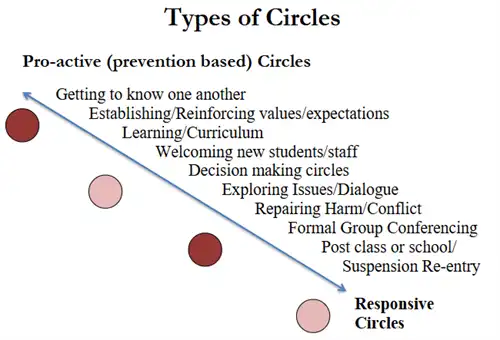
TYPES OF CIRCLES:
Pro-Active (prevention based) Circles
Getting ot know one another
Establishing/Reinforcing values/expectations
Learning/Curriculum
Welcoming new students/staff
Decision making circles
Exploring Issues/Dialogue
Repairing Harm/Conflict
Formal Group Conferencing
Post class or school/Suspension Re-entry
Responsive Circles
Proactive: Building strong community in the classroom and school
Responsive: Problem solving/ addressing issues
Proactively Responsive: Addressing problems or anticipating problems proactively
Academic: Academic content (prep, new, reflection)
Responsive: Problem solving/ addressing issues
Proactively Responsive: Addressing problems or anticipating problems proactively
Academic: Academic content (prep, new, reflection)


